





Kaieg is an online store offering authentic Pharaonic crafts and premium papyrus, inspired by Egypt’s ancient civilization with a modern touch.
Sale!
Categories: Pharmpharmacy Anteka
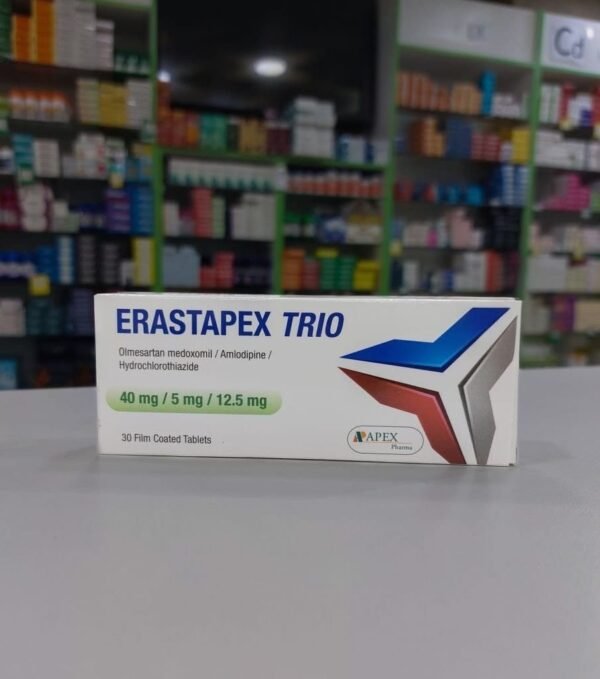
Erastapex Trio 30 tablets
Original price was: $5.00.$3.00Current price is: $3.00.
Erastapex Trio 30 tablets
Composition:
Each film-coated tablet contains:
Olmesartan medoxomil – 40 mg
Amlodipine besilate – 6.90 mg (equivalent to amlodipine 5 mg)
Hydrochlorothiazide – 12.5 mg.
Description:
Erastapex Trio is a fixed-dose combination antihypertensive drug containing three active components with complementary mechanisms of action to control blood pressure.
Olmesartan medoxomil is an angiotensin II receptor antagonist (ARB). It blocks the vasoconstrictor and aldosterone-secreting effects of angiotensin II, leading to vasodilation and a reduction in blood pressure.
Amlodipine is a calcium channel blocker (dihydropyridine derivative). It reduces peripheral arterial resistance by relaxing vascular smooth muscle, which dilates arteries and reduces the heart’s workload.
Hydrochlorothiazide is a thiazide diuretic. It promotes the excretion of excess water and sodium by the kidneys, reducing blood volume and cardiac output.
The combination of these substances provides a synergistic effect, allowing for achieving target blood pressure values in patients whose hypertension is not adequately controlled by dual therapy.
Indications:
– Treatment of essential hypertension.
– Add-on therapy: Erastapex Trio is indicated in adult patients whose blood pressure is not adequately controlled on the combination of olmesartan medoxomil and amlodipine taken as a dual-component formulation.
– Substitution therapy: Erastapex Trio is indicated as substitution therapy in adult patients whose blood pressure is adequately controlled on the combination of olmesartan medoxomil, amlodipine and hydrochlorothiazide, taken as a dual-component (olmesartan medoxomil and amlodipine or olmesartan medoxomil and hydrochlorothiazide) and a single-component formulation (hydrochlorothiazide or amlodipine).
Posology and Method of Administration:
Adults: The recommended dose is one tablet (40 mg/5 mg/12.5 mg) once daily.
Maximum recommended daily dose is 40 mg/10 mg/25 mg.
A step-wise titration of the dosage of the individual components is recommended before changing to the triple combination. Direct change from dual therapy may be considered when clinically appropriate.
Paediatric population: Not recommended for use in patients under 18 years of age.
Method of administration:
The tablet should be swallowed whole with a sufficient amount of fluid (e.g., a glass of water). It should not be chewed. It can be taken with or without food, at the same time each day.
Contraindications:
– Hypersensitivity to the active substances, to dihydropyridine derivatives, to sulfonamide-derived substances (since hydrochlorothiazide is a sulfonamide-derived drug), or to any of the excipients.
– Pregnancy.
– Severe renal impairment (creatinine clearance < 30 mL/min).
– Severe hepatic impairment, cholestasis, and biliary obstructive disorders.
– Refractory hypokalaemia, hypercalcaemia, hyponatraemia, and symptomatic hyperuricaemia.
– Due to the amlodipine component: Shock (including cardiogenic shock), severe hypotension, obstruction of the outflow tract of the left ventricle (e.g., high-grade aortic stenosis), haemodynamically unstable heart failure after acute myocardial infarction.
– Concomitant use with aliskiren-containing products in patients with diabetes mellitus or renal impairment (GFR ≤ 60 ml/min/1.73 m²).
Precautions:
– Hypovolaemia and sodium depletion: Symptomatic hypotension may occur. Correct this condition prior to administration.
– Renovascular hypertension: Increased risk of severe hypotension and renal insufficiency in patients with bilateral renal artery stenosis or stenosis to a single kidney.
– Renal impairment and kidney transplantation: Not recommended in severe renal impairment. Periodic monitoring of potassium and creatinine is recommended in impaired renal function.
– Dual blockade of the RAAS: Concomitant use with ACE-inhibitors, angiotensin II receptor blockers, or aliskiren is not recommended due to increased risk of hypotension, hyperkalaemia, and renal impairment.
– Hepatic impairment: Use with caution. Exposure to amlodipine and olmesartan is increased. Thiazides can precipitate hepatic coma in patients with advanced liver disease.
– Aortic and mitral valve stenosis, obstructive hypertrophic cardiomyopathy: Special caution is indicated due to the vasodilatory effect of amlodipine.
– Primary aldosteronism: Not recommended, as patients generally will not respond.
– Systemic lupus erythematosus: Exacerbation or activation has been reported with thiazides.
Side Effect:
– Infections and infestations: Upper respiratory tract infection, nasopharyngitis. Urinary tract infection, sialadenitis.
– Blood and lymphatic system disorders: Leucopenia, thrombocytopenia, bone marrow depression, neutropenia/agranulocytosis, haemolytic anaemia, aplastic anaemia.
– Immune system disorders: Anaphylactic reaction.
– Metabolism and nutrition disorders: Hyperkalaemia, hypokalaemia, anorexia, hyperglycaemia, glycosuria, hypercalcaemia, hypomagnesaemia, hyponatraemia, hypochloraemia, hypertriglyceridaemia, hypercholesterolaemia, hyperuricaemia, hypochloremic alkalosis, hyperamylasaemia.
– Nervous system disorders: Dizziness, headache, postural dizziness, presyncope, dysgeusia, hypertonia, hypoesthesia, paraesthesia, peripheral neuropathy, somnolence, syncope, convulsions, loss of appetite, tremor, extrapyramidal disorder.
– Eye disorders: Visual disturbance (including diplopia, blurred vision), lacrimation decreased, xerophthalmia, worsening of myopia, xanthopsia, acute myopia, acute angle-closure glaucoma, choroidal effusion.
– Ear and labyrinth disorders: Vertigo, tinnitus.
– Cardiac disorders: Palpitations, tachycardia, myocardial infarction, arrhythmia (including bradycardia, ventricular tachycardia, atrial fibrillation), angina pectoris.
– Gastrointestinal disorders: Diarrhoea, vomiting, nausea, constipation, dry mouth, abdominal pain, altered bowel habits, meteorism, dyspepsia, gastritis, gastric irritation, gastroenteritis, gingival hyperplasia, paralytic ileus.
– General disorders and administration site conditions: Asthenia, fatigue, peripheral oedema, chest pain, malaise.
Pregnancy and Lactation:
Pregnancy: Contraindicated.
Lactation: Not recommended. It is not known whether olmesartan or amlodipine are excreted in human milk. Hydrochlorothiazide is excreted in human milk and may inhibit lactation.
Storage:
Store at a temperature not exceeding 30°C in a dry place.
Keep out of the sight and reach of children.
Package:
A carton box containing 30 film-coated tablets.
