





Kaieg is an online store offering authentic Pharaonic crafts and premium papyrus, inspired by Egypt’s ancient civilization with a modern touch.
Sale!
Categories: Pharmpharmacy Anteka
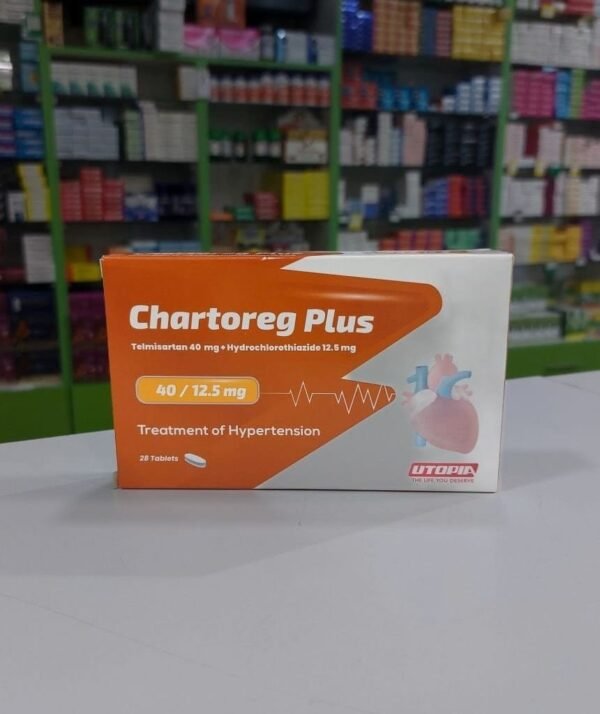
Chartoreg Plus 40/12.5 mg 28 tablets
Original price was: $5.00.$3.00Current price is: $3.00.
Chartoreg Plus 40/12.5 mg 28 tablets
Composition:
Each tablet contains 40 mg of telmisartan and 12.5 mg of hydrochlorothiazide.
Description:
Combined antihypertensive agent. It contains two active ingredients with complementary mechanisms of action to control blood pressure:
Telmisartan: Belongs to the class of angiotensin II receptor antagonists (ARBs). It blocks the vasoconstrictor effects of the hormone angiotensin II.
Hydrochlorothiazide: Belongs to the thiazide diuretic class. It increases the excretion of water and sodium from the body, reducing blood volume.
Therapeutic indications:
Treatment of essential hypertension.
Chartoreg Plus 40 mg/12.5 mg and 80 mg/12.5 mg are indicated in adults whose blood pressure is not adequately controlled on telmisartan alone.
Posology and method of administration:
Dosage: The tablet is taken once daily. The specific strength (40/12.5; 80/12.5; or 80/25) is determined by the physician based on achieved blood pressure control.
Method of administration: For oral use. The tablets should be taken with liquid, with or without food.
Contraindications:
– Hypersensitivity to telmisartan, hydrochlorothiazide, other sulfonamide-derived substances, or any excipients.
– Pregnancy (second and third trimesters). Must be discontinued as soon as pregnancy is detected.
– Cholestasis, biliary obstructive disorders, severe hepatic impairment.
– Severe renal impairment (creatinine clearance < 30 ml/min).
– Refractory hypokalaemia, hypercalcaemia.
– Concomitant use with aliskiren-containing products in patients with diabetes mellitus or renal impairment.
Special warnings and precautions for use:
– Renal impairment: Periodic monitoring of renal function is advised. Contraindicated in severe impairment.
– Hepatic impairment: Use with caution. Contraindicated in severe impairment.
– Renovascular hypertension: Increased risk of severe hypotension and renal insufficiency in patients with bilateral renal artery stenosis.
– Electrolyte imbalance: Can cause fluid or electrolyte imbalance (e.g., hypokalaemia, hyponatraemia, hypomagnesaemia, hypercalcaemia). Periodic monitoring is recommended.
– Other conditions: Use with caution in patients with aortic/mitral stenosis, obstructive hypertrophic cardiomyopathy, systemic lupus erythematosus, gout, diabetes, ischaemic heart disease.
– Photosensitivity: Photosensitivity reactions may occur. Sun protection is recommended.
– Non-melanoma skin cancer (NMSC): Risk of basal cell and squamous cell carcinoma may be increased. Regular skin examination is advised.
– Acute myopia and angle-closure glaucoma: A rare idiosyncratic reaction can occur. Discontinue treatment if symptoms occur.
Undesirable effects:
Possible side effects listed by frequency:
Common (≥1/100 to <1/10): Nausea, hypokalaemia.
Uncommon (≥1/1,000 to <1/100): Dizziness, asthenia (weakness), haemoglobin decreased.
Rare (≥1/10,000 to <1/1,000): Thrombocytopenia, headache, hypercalcaemia, hypomagnesaemia.
Very rare (<1/10,000): Hypochloraemic alkalosis, acute respiratory distress syndrome (ARDS).
Frequency not known: Anaphylactic reactions, hypersensitivity, hepatic function abnormal, jaundice, pancreatitis, diabetes mellitus, photosensitivity, lupus-like syndrome, acute angle-closure glaucoma, acute myopia, choroidal effusion, renal dysfunction, aplastic anaemia, leukopenia, neutropenia, non-melanoma skin cancer.
Pregnancy:
Contraindicated in the second and third trimester. Exposure during these trimesters can cause fetal injury and death. Discontinue therapy as soon as pregnancy is detected.
Lactation:
Not recommended. It is unknown if telmisartan is excreted in human milk. Hydrochlorothiazide is excreted in milk. A decision must be made to discontinue nursing or discontinue the drug.
Storage:
Store at temperatures not exceeding 30°C in a dry place.
Package:
A carton box containing 28 Film-coated tablets in blisters.
